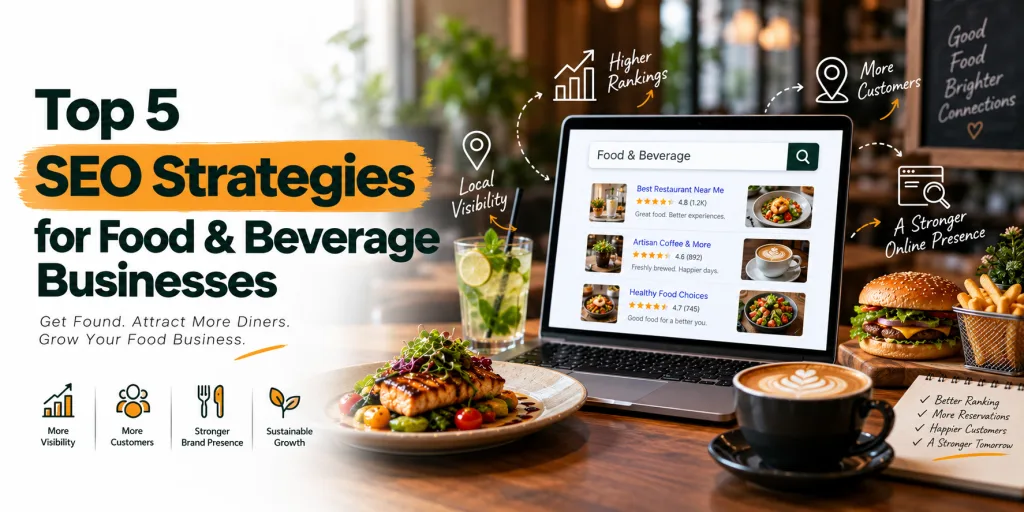
The food and beverage industry has never been more competitive. Restaurants, cafés, cloud kitchens, bakeries, beverage brands, and online food stores are all fighting for attention on Google and social platforms. A great product isn’t enough anymore — customers need to be able to find you online before they can buy from you.
That’s where a solid, well-planned set of SEO strategies for food and beverage businesses comes in. Done right, it helps brands rank higher, attract the right visitors, and turn searches into orders, reservations, and sales. Below are the five strategies that matter most, followed by the mistakes that quietly undo them.
1. Optimize Your Website for Food & Beverage Keywords
Among the most foundational SEO strategies for food and beverage brands is keyword research — everything else is built on top of it. Keywords are simply the words and phrases customers type into Google, and your website should be built around the ones that match your products, location, and audience.
A restaurant might target “Italian restaurant in Delhi,” while an online food brand might go after “buy organic honey online.” Break your keywords into three groups:
Primary keywords — describe your core offering: food and beverage companies, healthy food products, online food store, restaurant SEO, beverage brands.
Long-tail keywords — more specific, often easier to rank for: best healthy snacks for office, organic food products online, best coffee shop near me, sugar-free beverages online.
Location-based keywords — critical for local businesses: best restaurant in Dehradun, café near Connaught Place, bakery in Chandigarh, food delivery in Gurgaon.
Weave these naturally into titles, headings, URLs, meta descriptions, product copy, and image alt text — never force them in. A professional SEO Services engagement typically starts right here, mapping out exactly which terms your business can realistically win.
2. Create High-Quality Food & Beverage Content
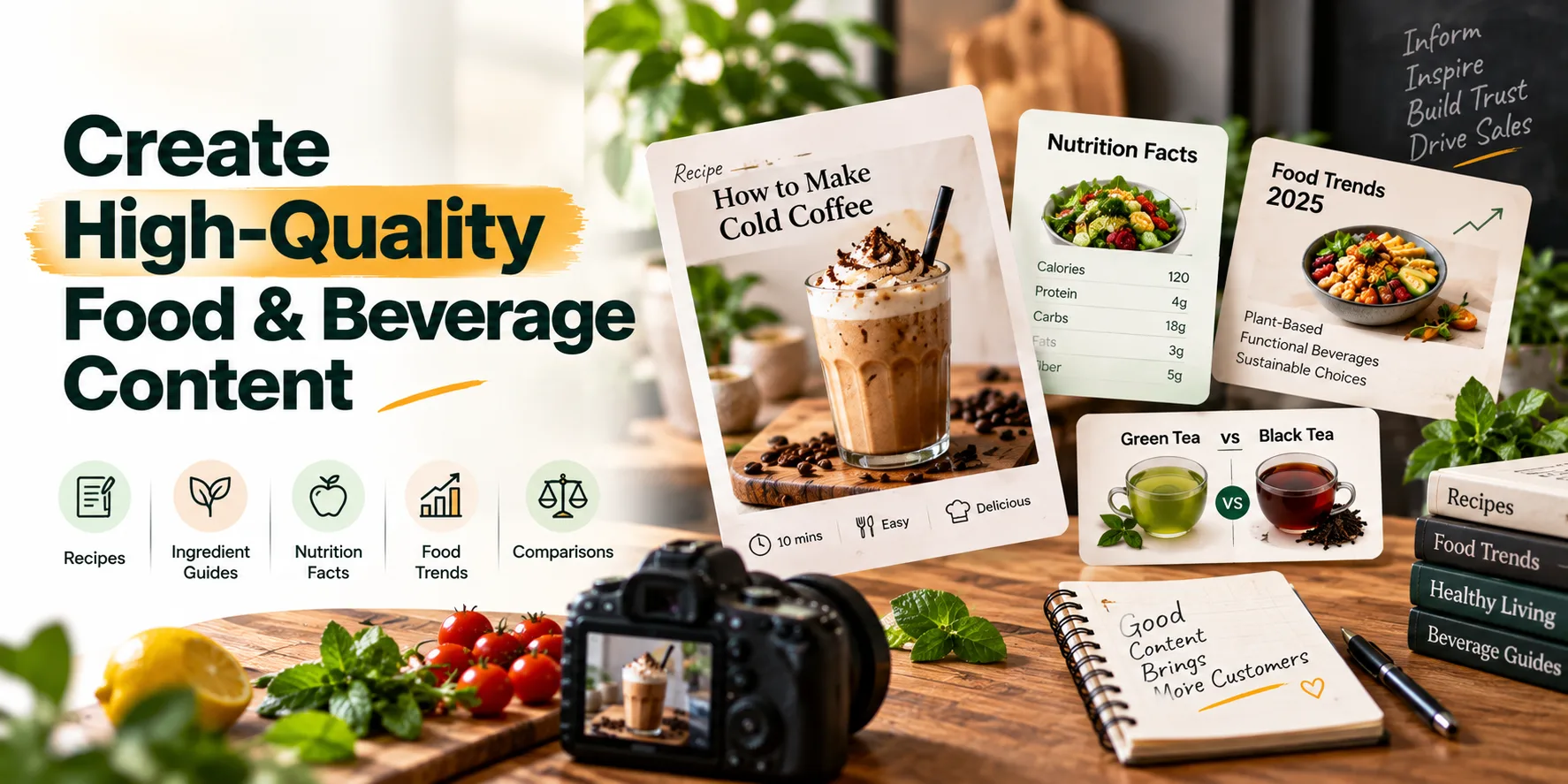
Customers don’t only search for products — they search for recipes, ingredient guides, nutrition facts, food trends, and comparisons (“Green Tea vs. Black Tea,” “Fresh Juice vs. Packaged Juice”). Publishing useful content lets you reach people earlier in their decision-making, before they’re even ready to buy — and it’s one of the more overlooked SEO strategies for food and beverage businesses looking to build long-term traffic rather than one-off clicks.
The key is matching content to search intent. Someone typing “how to make cold coffee” wants a recipe; someone typing “buy cold coffee online” wants a store. Build separate pages for each intent rather than trying to serve both with one piece of content.
Good food and beverage content should be:
Genuinely helpful and easy to follow
Original, not lifted from competitors or suppliers
Refreshed whenever products, prices, or trends change
An ongoing Content Marketing plan keeps this pipeline consistent instead of relying on occasional bursts of blog posts.
3. Focus on Local SEO to Attract Nearby Customers
For restaurants, cafes, bakeries, and local beverage brands, local search is where the real money is. Searches like “restaurant near me” or “best cafe nearby” carry serious buying intent — the person is often deciding right now.
Start with your Google Business Profile:
Keep name, address, phone number, and hours accurate and consistent everywhere
Add high-quality photos of food, drinks, and your space
Post updates regularly (offers, new menu items, events)
Then actively build reviews. Encourage genuine customers to leave them, and respond to every review — good or bad — since it signals to future customers (and to Google) that you’re an active, trustworthy business. Location-specific landing pages and local backlinks add further weight here, and this is exactly the kind of work a dedicated local SEO package is built to handle.
4. Optimize Product Pages for Search Engines
For food manufacturers, D2C brands, and online stores, the product page is where SEO meets conversion. Each page needs enough detail for both search engines and shoppers to understand exactly what they’re getting — ingredients, size, flavor or variant, and usage or storage instructions.
Never publish manufacturer-supplied descriptions as-is; duplicate content across multiple sites is one of the fastest ways to lose ranking potential. Write unique copy, use descriptive (not vague) product titles with your main keyword worked in naturally, and pair everything with high-quality images that have proper file names and alt text. Structured data can also help Google surface price, availability, and review information directly in search results — something worth setting up as part of a broader e-commerce SEO effort.
5. Build High-Quality Backlinks and Online Authority
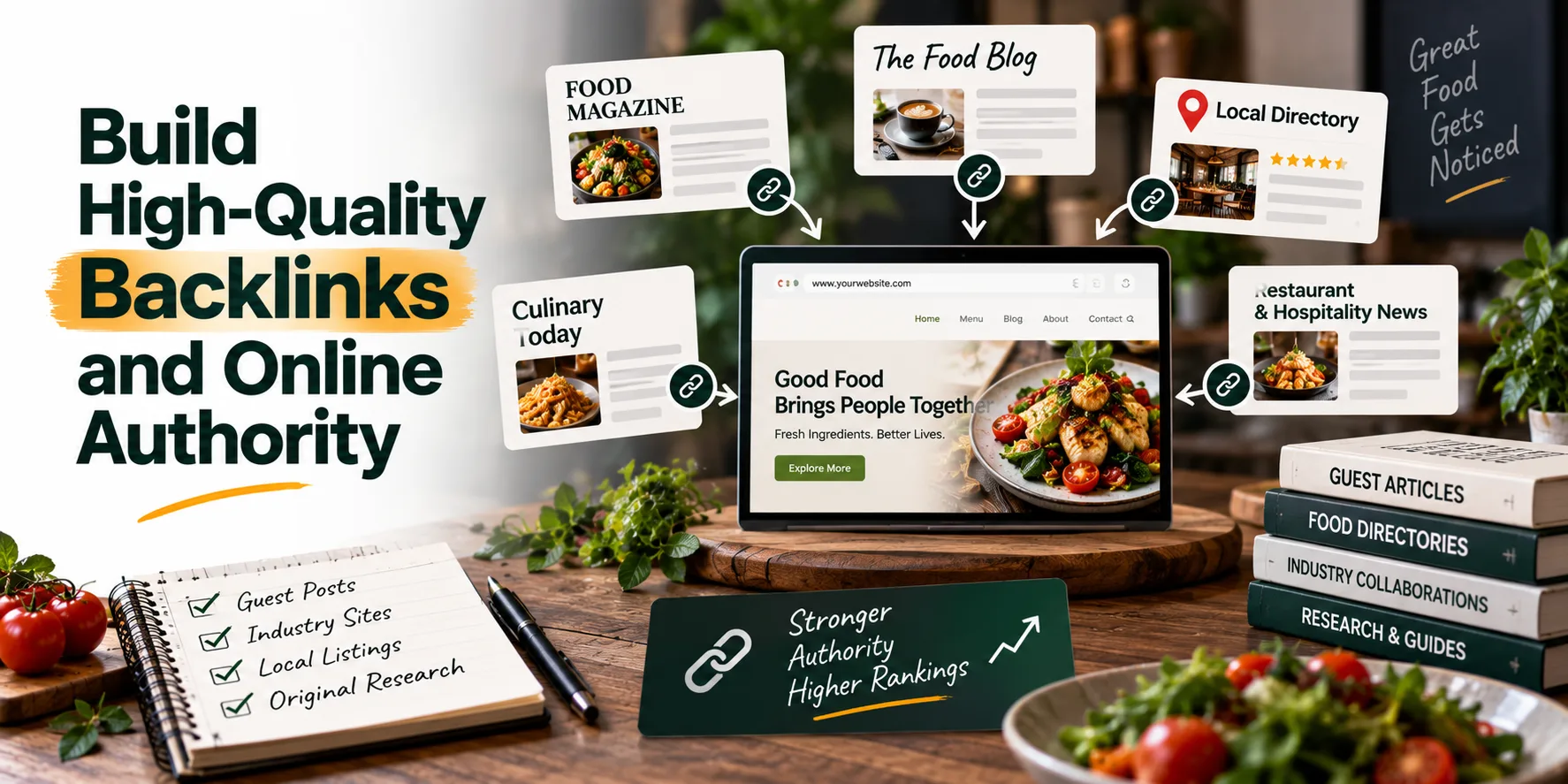
Backlinks — links from other websites pointing to yours — tell Google your site is credible. But quality beats quantity every time: a handful of links from respected food publications or local directories will do more for you than hundreds of low-value ones.
Ways to earn them naturally:
Guest articles and collaborations with food bloggers or industry sites
Listings in relevant local and food-specific directories
Original research, in-depth guides, or trend reports that people actually want to cite
Avoid bulk-bought spammy links entirely — Google’s own spam policies flag link schemes directly, and they create more risk than reward that can actively damage a site’s reputation.
Common SEO Mistakes Food & Beverage Brands Should Avoid
Even brands that invest in SEO can undercut their own progress. Watch out for:
Keyword stuffing — repeating a phrase unnaturally instead of writing for readers first.
Ignoring local search — an incomplete Google Business Profile or missing reviews quietly kills local visibility.
Duplicate product descriptions — copying supplier or manufacturer text word-for-word.
Slow-loading websites — usually caused by unoptimized, high-resolution food photography (check your Core Web Vitals to see where the drag is coming from).
Poor mobile experience — a real problem when most food searches happen on phones.
Not tracking performance — without monitoring traffic, rankings, and conversions, it’s impossible to know what’s actually working.
Why SEO Matters for the Food & Beverage Industry
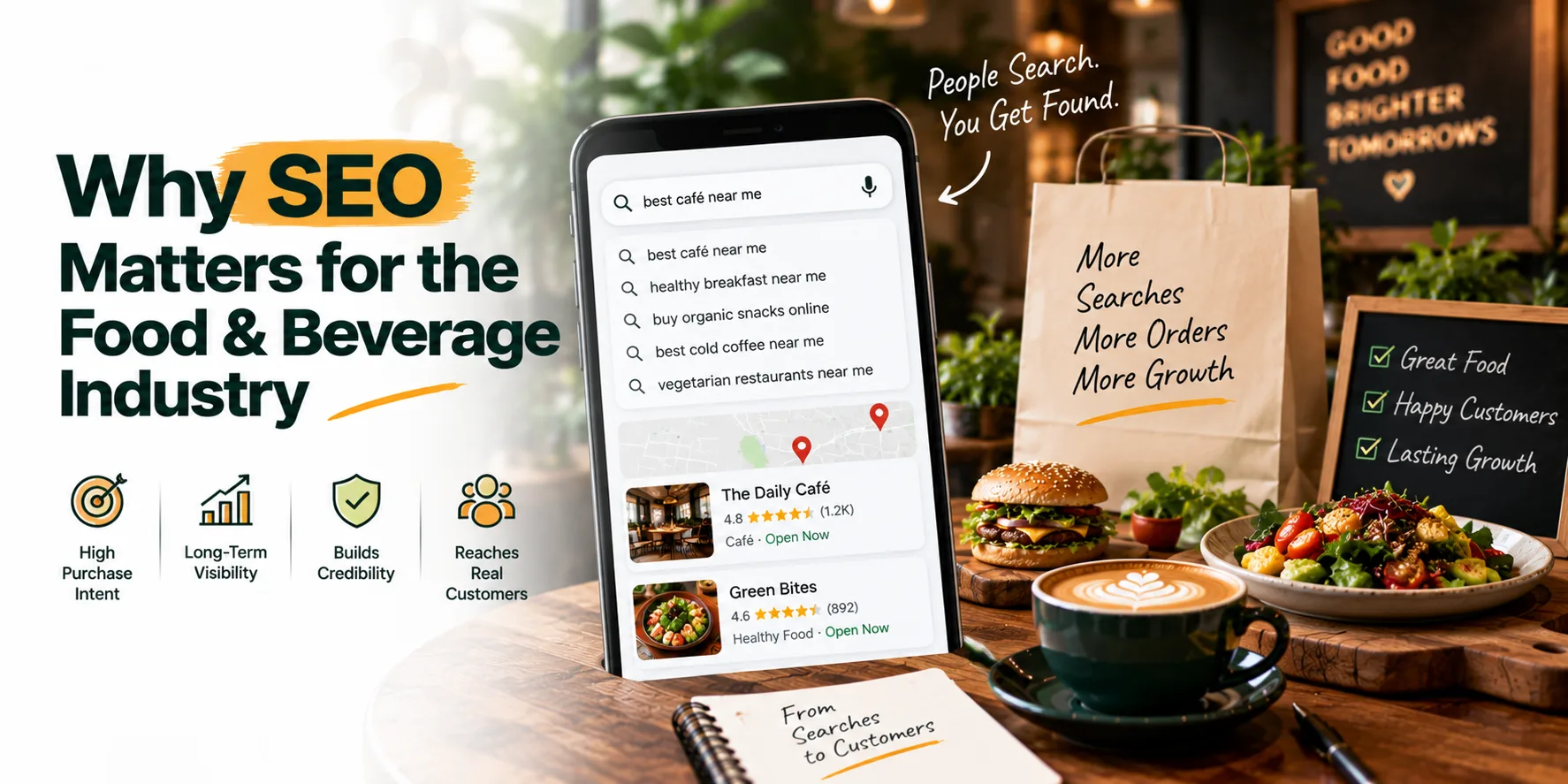
Search traffic in this space tends to carry strong purchase intent — someone searching “best café near me” or “buy organic snacks online” is often just one click away from ordering. That’s what makes organic visibility so valuable: it keeps working for you without an ongoing ad spend, and it builds credibility that paid placements can’t. This is ultimately why SEO strategies for food and beverage companies deserve a dedicated budget rather than an afterthought.
Consumer behavior is also shifting toward conversational search — “What’s the best healthy breakfast near me?” instead of short keyword phrases — so content that follows Google’s helpful-content guidance and directly answers real customer questions will increasingly outperform content built purely around exact-match keywords.
Should Food & Beverage Businesses Hire an SEO Agency?
Running SEO alongside daily operations — menus, inventory, staffing, orders — is a lot to juggle. An experienced agency can take on keyword research, local SEO, content and on-page optimization, and technical fixes, freeing your team to focus on the business itself. For many owners, outsourcing the full set of SEO strategies for food and beverage growth is simply more efficient than building that expertise in-house.
Why Choose Zaclab
Zaclab Technologies is a Dehradun-based digital marketing agency that helps food and beverage businesses build exactly this kind of search visibility — combining SEO, performance marketing, and web development into one strategy tailored to your goals. Whether you’re a single-location restaurant or a growing D2C food brand, the right mix of these services can turn organic search into a dependable source of new customers.
Conclusion
Reliable SEO strategies for food and beverage businesses are no longer optional for brands that want to be found online. Getting the fundamentals right — the right keywords, genuinely useful content, strong local presence, well-optimized product pages, and credible backlinks — compounds over time into steady, sustainable traffic. Results won’t show up overnight, but brands that invest in organic visibility now will hold a real advantage as competition in this space keeps growing.
FAQs
Q1. What are the top SEO strategies for food and beverage businesses?
Keyword research, high-quality content, local SEO, product page optimization, and building authoritative backlinks.
Q2. Why is SEO important for food and beverage businesses?
It helps brands improve Google visibility, attract potential customers, and generate more website traffic without relying solely on paid ads.
Q3. How does local SEO help restaurants?
It helps restaurants appear in searches like “best restaurant near me,” driving highly relevant, nearby traffic.
Q4. What keywords should food businesses target?
Keywords tied to your products, services, and location — for example, “organic snacks online” or “best cafe near me.”
Q5. How can food brands improve product page SEO?
Use descriptive titles, unique product descriptions, relevant keywords, optimized images, and clear internal links.
Q6. Does blogging help food and beverage SEO?
Yes — blog content targets informational searches, answers customer questions, and supports product pages with additional organic traffic.
Q7. How can restaurants improve their Google rankings?
Optimize the website, Google Business Profile, location pages, reviews, images, and local keywords together.
Q8. Are backlinks important for food and beverage SEO?
Yes — relevant, high-quality backlinks strengthen site authority and improve search visibility.
Q9. How long does food and beverage SEO take to show results?
It varies by competition, site quality, content, and backlink profile, but most brands see meaningful movement over several months of consistent work.
Q10. Should food businesses hire an SEO agency?
An agency can manage keyword strategy, content, technical SEO, local SEO, and performance tracking as one coordinated effort — which is often more effective than handling it piecemeal in-house